
- Home
- Testing & Design
- Process Development
Process Development & Scale-Up
Artisan uses what we learn from your material and pilot test to develop the basis for commercial equipment selection and design. Actual operating results, observed material behavior, production requirements, and plant constraints are considered together so the scale-up reflects how the process behaves, not simply how it’s assumed to.
OVERVIEW
What Is Process Development & Scale-Up?
Process development and scale-up is the engineering bridge between pilot testing and commercial implementation.
Ready to move from pilot results toward a commercial equipment solution? Our engineers are available to discuss your application.
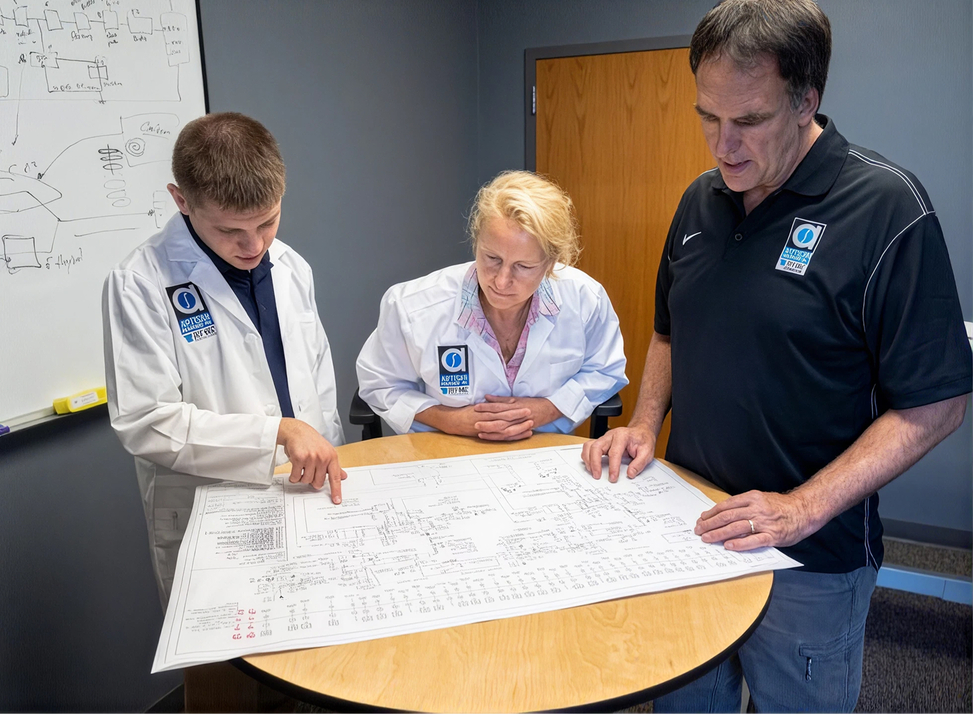
What Process Development & Scale-Up Defines
Operating Conditions
Temperature, pressure, vacuum level, feed rate, rotor speed, residence time, vapor load, and product discharge behavior can all influence commercial performance.
Artisan uses pilot results, material observations, and engineering analysis to define an operating range appropriate for the separation objective, material, and production target.
Equipment Sizing and Configuration
Scale-up determines the equipment size and system arrangement required for the intended capacity.
This may include heat-transfer area, single-stage or multistage configurations, feed handling, vacuum requirements, condenser design, product collection, controls, and integration with upstream and downstream equipment.
Commercial Economics and Operating Considerations
The equipment approach must also make sense within the customer’s production environment.
Artisan considers factors such as utility demand, available footprint, throughput, yield protection, solvent or product recovery, waste generation, operating efficiency, and plant integration when developing the commercial process direction.
How We Do It
Artisan’s Approach to Process Development & Scale-Up.
Process Basis Development
Each engagement begins by defining the process objective, feed characteristics, product targets, expected throughput, operating limits, and success criteria. This creates the technical framework for equipment selection, pilot planning, scale-up calculations, and commercial system development.
Key inputs may include material composition, volatile or solvent content, solids loading, viscosity profile, heat sensitivity, fouling tendency, target concentration or residual limits, yield requirements, available utilities, and plant integration needs.
Pilot Data Translation
Pilot-scale testing provides the operating evidence that calculations and material data alone cannot supply and moves beyond assumptions to derisk the process with your actual material.
Artisan evaluates separation performance, heat-transfer behavior, vacuum response, product quality, material balance, and equipment handling characteristics. We then use the data collected during testing to analyze heat transfer behavior, evaporation or stripping performance, vacuum response, residence behavior, product quality, material balance, and equipment handling characteristics.
Engineering Analysis
Artisan applies the established process basis and pilot results to equipment sizing, heat and material balances, utility requirements, and system recommendations. Depending on the project, the analysis may also define process flow, equipment specifications, controls, instrumentation, and integration requirements while identifying opportunities to improve efficiency, recover valuable materials, reduce waste, and strengthen overall operating performance.
Commercial Equipment Direction
Artisan then defines the equipment and system approach required for commercial operation. Recommendations may include Rototherm®, Evaporator/Stripper™, Short Path Stripper, vacuum and condensation equipment, staged arrangements, modular systems, controls, and other supporting process equipment.
Because the commercial direction is built on the material observations and operating results collected during testing, the path from pilot performance to equipment design remains connected.
Ready to Scale Your Process?
- (781) 893-6800
- 44 Campanelli Pkwy, Stoughton, MA 02072