
- Home
- Separation Equipment
- ROTOTHERM® Thin-Film Evaporators (TFE)
ROTOTHERM® Thin-Film Evaporators (TFE)
Concentrate or dry difficult-to-handle process streams with unparalleled efficiency. The ROTOTHERM®’s robust, scalable horizontal design handles what vertical wiped-film evaporators cannot.
Overview
Designed for the Process Streams Other Equipment Can’t Handle
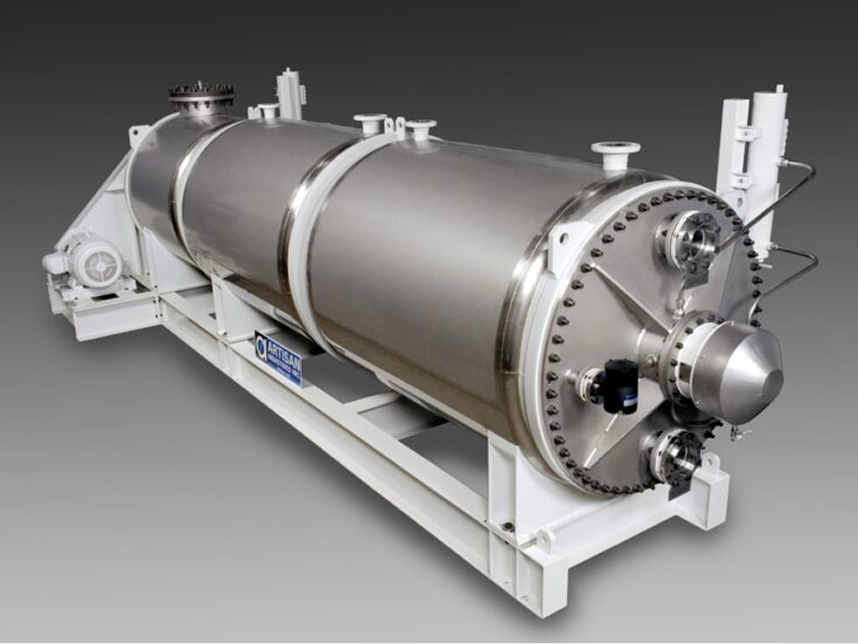
The Rototherm® Thin-Film Evaporators (TFE) concentrates or dries many difficult-to-handle process streams with unparalleled efficiency. Unlike traditional vertical wiped-film evaporators, the Rototherm®’s robust, scalable horizontal design enables liquid-to-powder drying for many materials, with a low height requirement that simplifies installation.
Every Rototherm® is designed for optimal performance based on data specific to the user’s process. Size depends on the design feed rate, evaporation rate, operating temperature, pressure, and final product specifications. Equipment can be designed for pharmaceutical, food, or chemical service, and for specific location requirements including geographic and hazardous area classification. All specific design details, including pressure vessel code, temperature and pressure rating, polish, elastomers, seal type, and electrical connections, are confirmed with the user during the design phase.
Technology Advantages
Enhanced Heat Transfer
Uniform Distribution
Preserved Product Quality
Key advantages of Rototherm Horizontal Thin-Film Evaporators (TFE) vs. Vertical Wiped Film Evaporators (WFE)
Heat Transfer
Material Handling
Cleaning & Maintenance
Easy to clean using a small volume of CIP solution. No flushing or disassembly required. Maintenance is significantly easier, leading to a lower cost of ownership.
Installation
What the ROTOTHERM® Is Used For
- Concentrating and drying waste and/or products
- Recovering solvents from waste/mixed streams
- Preconcentration prior to spray-drying
- Removing solids prior to distillation
- Recovering heat-sensitive APIs, intermediates, or fine chemicals
- Concentrating brine solutions containing PFAS
- Continuous reactors
- Post-reaction stripping
- Devolatilization/dewatering/stripping
- Process intensification by combining unit operations
How It Works
How the ROTOTHERM® Operates
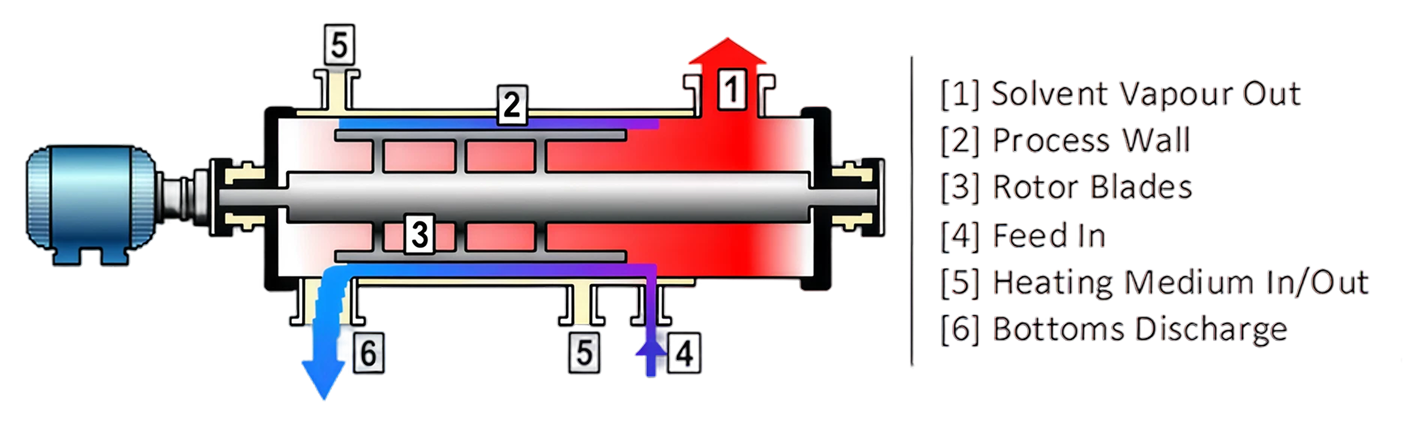
The rotor blades produce centrifugal force, holding a thin film of feed material against the heated process wall.
The turbulent, thin film between the rotor blade and process wall covers the entire heated section, regardless of feed or evaporation rates. It is constantly renewed by the incoming feed, while more concentrated material is displaced towards the bottom discharge nozzle.
High vacuum minimizes processing temperature and residence time is short, reducing degradation of heat-sensitive materials.

Design & Operation Principle
Co-Current Flow
Counter-Current Flow
Technology in Action
The ROTOTHERM® Running
Rototherm® TFE feature a high-speed rotor that uses centrifugal force to keep the feed material against the heated process wall. This creates a turbulent, thin film between the rotor blades and the process wall, covering the entire heated surface at all times, regardless of feed or evaporation rates.
Configurations
Six ROTOTHERM® Configurations
The Rototherm® platform is available in six specialized configurations, each designed for a specific class of process application.
Rototherm® E
Concentration / Evaporation
The most popular Rototherm® design, ideal for concentrating liquid feed material to a flowable liquid or slurry. With over 500 installations worldwide, it has been continuously improved since the 1960s to enhance processing capabilities.
Applications
Research and development teams who need to validate a process before committing to production-scale equipment.
Rototherm® P
Liquid to Powder Drying
Applications
Rototherm® TS
Twin-Screw Extrusion Outlet
Applications
Rototherm® Mini
Lab-Scale Continuous
Offers continuous, scalable, and cost-effective separation for R&D teams, preserving product quality, increasing throughput, and saving energy. Utilizes the same thin-film separation technology as production-scale Rototherm® units.
Applications
Rototherm® Reactor
Continuous Reactor
Applications
Rototherm® Foam-Breaker
Foam-Breaking Configuration
Applications
Not sure which Rototherm® configuration is the
right fit for your process? Our team is here to help.
Technical Specifications
Size Range, Materials & Operating Parameters
Advantages Over Vertical WFE
- Gravity does not impact performance, the film remains fully wetted
- Approximately 20% higher heat and mass transfer coefficients
- Inherently more suitable for hard-to-process materials, high evaporation rates, and significantly less entrainment
- High turndown ratio (10:1)
- Easy to clean, less than 15 minutes using a small volume of CIP solution. No flushing or disassembly required
- Requires less structural height for installation on site
- Installation on site is easier and typically costs 20% less
- Maintenance is significantly easier, leading to a lower cost of ownership
FAQs About Artisan’s ROTOTHERM®
What is TFE and how does it work?
A thin-film evaporator spreads a fluid into a thin, turbulent layer across a heated surface using high-speed rotating blades. This results in excellent heat transfer and rapid evaporation. Because the film is continuously renewed, materials spend very little time on the heated surface, which protects heat-sensitive compounds and improves product quality.
What makes TFE different from other separation technologies?
Unlike conventional distillation or kettle boiling, thin-film evaporation uses a continuously refreshed, ultra-thin liquid layer that evaporates quickly and uniformly. Short residence times, vacuum operation, and efficient heat transfer minimize thermal degradation and provide higher purity and higher yields. The self-cleaning motion of the wipers also reduces fouling and extends operating time between cleanings.
Why is TFE ideal for heat-sensitive materials?
Thin-film evaporators reduce thermal exposure by maintaining very short residence times and allowing operation under vacuum. These conditions lower boiling temperatures and prevent degradation. As a result, pharmaceuticals, natural extracts, specialty chemicals, and other heat-sensitive materials maintain stability, color, potency, and overall quality.
Ready to Evaluate the ROTOTHERM® for Your Process?
- (781) 893-6800
- info@artisanind.com
- 44 Campanelli Pkwy, Stoughton, MA 02072