
- Home
- Testing & Design
- Limited Tolling
Limited Tolling
When a process has moved beyond initial testing but commercial equipment is not yet in place, limited tolling gives engineering and production teams a controlled path to generate material, confirm operating strategy, and gather the process data needed for scale-up decisions.
OVERVIEW
What Is Limited Tolling?
Unlike a standard pilot test, limited tolling focuses on repeatable processing over a defined campaign. The objective is not only to confirm the separation performs as expected, but to produce usable material while capturing the operating information needed to move toward full-scale equipment with greater confidence.
When Limited Tolling Makes Sense
MARKET TRIAL & INTERIM MATERIAL
Generate material for customer evaluation, product qualification, or early market testing while permanent production equipment is still being planned.
SCALE-UP CONFIRMATION
Longer runs show how the process holds up over time, giving a firmer basis for equipment sizing, operating conditions, and throughput expectations.
PROCESS IMPROVEMENT WORK
Study alternate operating conditions or separation strategies before introducing changes into a live production environment.
How We Do It
Artisan’s Approach to Limited Tolling
Process Definition
Each limited tolling program begins with a clear definition of the material, target product condition, quantity requirements, operating constraints, and downstream use of the processed material.
Custom Equipment Configuration
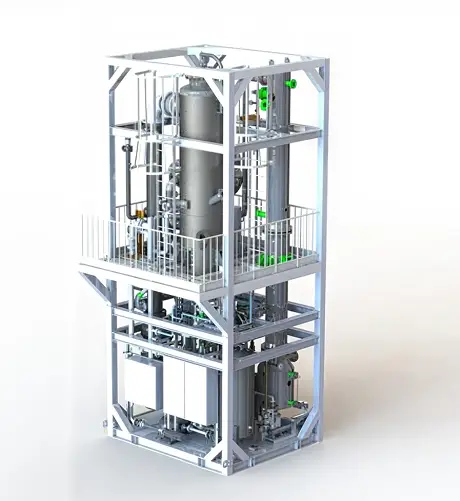
Artisan configures single-stage or multi-stage pilot systems around the separation objective, drawing on thin film evaporation, stripping, and short path operation with the vacuum and condensing equipment each requires. Process simulation and Artisan's scale-up history inform the configuration before the first run. Systems are built around how the material actually behaves - viscous, heat-sensitive, solvent-bearing, prone to fouling, rather than forced into a fixed test format.
Controlled Pilot Plant Operation
Artisan runs the process under controlled conditions, with instrumentation matched to the equipment arrangement: feed rate, temperature, vacuum level, and rotor speed among the parameters tracked. Extended operation exposes what a short test can't: handling limits, drift, and how consistently the process holds over a full campaign.
Data and Documentation
Limited tolling generates practical operating data for the next stage of development - material balance information, product observations, condensate or distillate behavior, workable operating ranges, throughput estimates, and recommendations for commercial system design.That gives engineering and operations a real basis for deciding how the process gets scaled and specified.
Ready to Produce More Material?
- (781) 893-6800
- info@artisanind.com
- 44 Campanelli Pkwy, Stoughton, MA 02072